

Property Inspections in Phuket: Snagging, Construction Checks and Resale Surveys
The short version
- A property inspection is an independent check you commission at handover of a new home, at agreed stages of an off-plan villa build, or before buying a resale home
- Under the standard condo contract the developer is liable for at least five years for structure and two years for other parts; a builder’s default period is one year, or five for a non-wooden structure
- Get the report before you accept the keys or agree the price, and have your lawyer turn its findings into written conditions
Updated November 2026
A property inspection in Phuket is an independent check of a home’s condition by an inspection firm or engineer you hire, and buyers usually commission one at three moments. The most common is the handover or snagging inspection of a new condo or villa. The others are checks during construction of an off-plan villa, where the contract gives you site access, and a survey before buying a resale home. What you get is a written defects list, which is evidence to negotiate with or base a claim on. It does not certify that the home is sound.
When should you get a property inspection in Phuket?
Get one before you sign anything that accepts the property or commits you to the price. That point differs for each kind of purchase.
| Moment | What the inspection is for | The law it sits beside |
|---|---|---|
| Handover of a new condo or villa (snagging) | A list of defects for the developer to fix before you accept the keys | Condo: the standard sale contract under Condominium Act s.6/2. Sale of a house: Civil and Commercial Code s.472 to 474 |
| During construction of an off-plan villa | Checking work at stages, such as foundations, structure and roof, before it is covered up | Your contract’s access and stage-payment terms. A construction contract is hire of work, s.587 onwards |
| Before buying a resale home | The condition of an existing home, so it can go into the price or the conditions of sale | Civil and Commercial Code s.472 to 474, and any exclusion clause under s.483 and s.485 |
The broader differences between buying new and buying existing are in Off-plan vs resale property in Phuket: how to choose.
What does a handover or snagging inspection check?
A snagging inspection walks a finished home before you accept it and lists everything that is incomplete, damaged or not working. Some snags are normal on any new build, and the handover walk is where small items get caught.
If I were buying, I would ask the inspector to cover these, with photos and locations for each finding:
- Structure and finishes: cracks in walls, ceilings and floors, hollow or uneven tiles, doors and windows that stick.
- Roof and waterproofing: the roof, balconies, terraces, wet rooms and window seals, and any stains on ceilings.
- Electrics: every switch, socket and circuit, the distribution board and the air conditioning.
- Plumbing and drainage: water pressure, leaks under basins, slow drains, and where terrace and roof water goes.
- The pool, on a villa: the plant room, pumps, filtration and any leaks around the shell.
On a condo, the inspection covers your unit. The common property is the juristic person’s concern, though a leak from above or a shared pipe can show up inside your walls.
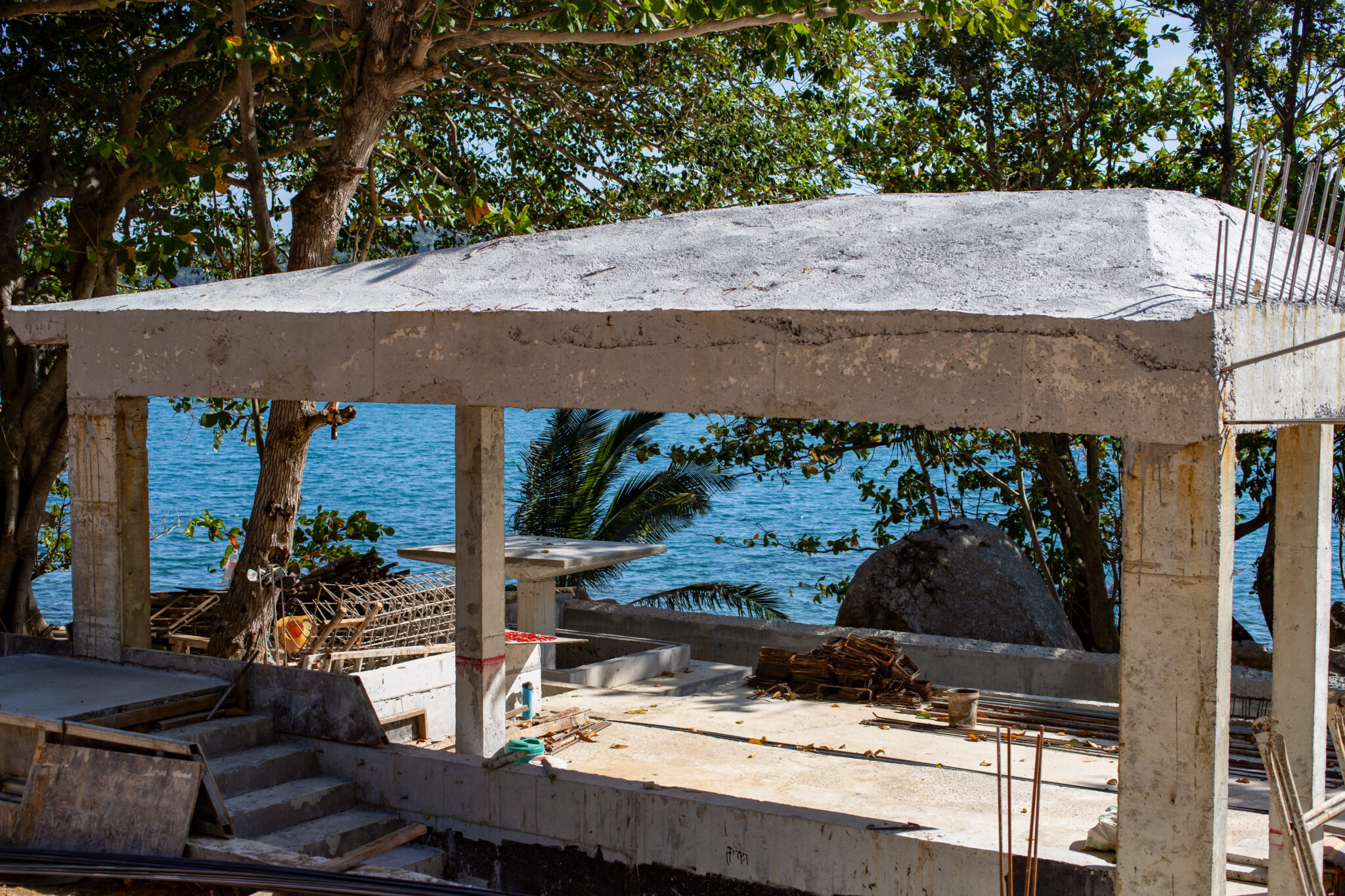
Can you inspect an off-plan villa during construction?
Only if your contract gives you, or someone you appoint, access to the site. Building sites have their own safety rules, so access needs agreeing in writing before you sign.
Where access is agreed, the useful visits are timed to work that will later be hidden. Foundations, the structural frame, the roof before it is closed in, and waterproofing before tiling are the usual points. A stage payment tied to a stage inspection gives both sides a clear moment to agree the work is done.
The questions to put to a villa developer before any deposit are in Will This Developer Finish Your Villa?, and how off-plan contracts are usually structured is in Buying Off-Plan in Phuket.
What does a pre-purchase inspection of a resale home cover?
It covers the condition of a home that has been lived in, so age and weather matter more than finishing. Kasikornbank’s checklist for buying a second-hand house lists the structure, cracks, roof leaks, ceiling stains and mould, electrics, plumbing and signs of termites. It also suggests hiring an inspector to make the check more thorough.
On a Phuket villa I would add the pool plant, the retaining walls on a sloping plot, and the drainage around the house. I would also ask the seller for the permits, the drawings and any repair invoices. A file like that tells you as much as the walk-through. The paperwork side of a purchase is in the Thailand Property Due Diligence Checklist.
Who carries out property inspections in Phuket?
Independent inspection firms and engineers carry them out, usually hired and paid by the buyer. Engineering services are a licensed activity in Thailand, regulated by the Council of Engineers (สภาวิศวกร).
Before booking, ask who will sign the report and whether that person is a licensed engineer. Ask for the scope in writing: which systems are covered, whether the roof space and pool plant are included, and when you receive the report. Ask for a sample report, too. I could not find a published price for inspections in Phuket that I would rely on, so compare two written quotes against the same scope.
How long is a developer liable for defects in Thailand?
For a condominium, the standard sale contract makes the developer liable for at least five years for defects in the structure and fixed equipment, and at least two years for other parts. That standard form is set by the Ministry of Interior under section 6/2 of the Condominium Act, added in 2008. Under the standard form, both periods run from the date the condominium itself is registered, so a late transfer to you leaves less of them.
A villa built for you under a construction contract is a hire of work under the Civil and Commercial Code. Under section 600, unless the contract says otherwise, the contractor is liable for defects that appear within one year of delivery. For a structure on land other than a wooden building, that period is five years. Section 601 then gives one year from the day a defect appears to bring a claim.
For a sale, whether resale or a finished new home, section 472 makes the seller liable for defects that reduce the property’s value or its fitness for use, whether or not the seller knew. Section 474 gives one year from discovering the defect to bring a claim. A sale contract can exclude that liability under section 483. Section 485 says such a clause does not cover the seller’s own acts, or facts the seller knew and concealed.
Which of these applies depends on how your purchase is documented. Your lawyer confirms how they apply to your contract.
What is an inspection report worth legally?
It is evidence of the property’s condition on a given date, and a basis for negotiation or a claim. Your lawyer decides how to use it.
The timing is what gives it weight. Under section 473, a seller is not liable for a defect the buyer knew of at the time of sale, or would have found with reasonable care. Nor for one that was apparent at delivery where the buyer accepted the property without reservation. Section 598 says the same for a contractor whose defective work is accepted without reservation, unless the defect could not have been found at the time or was concealed. A dated report, handed over before you accept, is how you record your reservations.
How do you fit an inspection into the buying process?
Build it into the documents from the start. This is the order I would follow as a buyer:
- Ask for inspection access in writing in the reservation or sale agreement, with the timing and who may attend.
- Book the inspector early, so the report arrives before any deadline to accept or pay.
- Time the handover inspection before you sign the acceptance or transfer, and attach the defects list to any acceptance you sign.
- Have your lawyer make agreed repairs a written condition, with a date to complete them and a re-inspection.
- Note the dates: the handover date, the end of each defects period, and when any retention is due for release.
A second look a few weeks into ownership is worth diarising. Some leaks only show after the first heavy storm, and the defects periods above allow for that.
Why does the wet season matter for an inspection in Phuket?
Rain tests roofs, seals and drainage in a way a dry-day inspection cannot. Thailand’s official rainy season runs from mid-May to mid-October, and rain in the South continues into December.
Flash floods sent mud and rocks through Patong on 26 October 2026. Phuket Provincial Announcement No. 23/2026, dated 29 October, declared villages 1 to 4 in Karon a flood disaster area, and the Department of Disaster Prevention and Mitigation issued an urgent evacuation warning over landslide risk in Karon the same day. What to ask about water before buying is in Phuket’s Floods This Wet Season.
For an inspection, that means asking the inspector to look at where water goes around the home as well as inside it. On a hillside plot I would want a view on the retaining walls and the slope above. If you can, see the home once after heavy rain.
Should you inspect your own property before selling?
A pre-sale inspection lets an owner find what a buyer’s inspector will find, and decide what to fix first. Repairing a roof leak or replacing tired pool plant before listing removes an item from the buyer’s negotiation.
Where you choose not to fix something, disclosing it with the report is the cleaner course. Section 485 means an exclusion clause does not protect a seller over facts known and concealed. Which repairs are worth doing before a sale is weighed in Renovating a Villa in Phuket.
Property inspections in Phuket: questions buyers ask
When should I get a property inspection in Phuket?
Before you sign anything that accepts the property or commits you to the price. That means at handover of a new condo or villa, at agreed stages of an off-plan villa build if your contract gives access, and before buying a resale home.
How long is the developer warranty on a new condo in Thailand?
Under the standard sale contract set under section 6/2 of the Condominium Act, the developer is liable for at least five years for defects in the structure and fixed equipment, and at least two years for other parts. Your lawyer confirms how it applies to your contract.
How long is a builder liable for defects in Thailand?
Under section 600 of the Civil and Commercial Code, unless the contract says otherwise, a contractor is liable for defects that appear within one year of delivery, or five years for a structure on land other than a wooden building. Section 601 gives one year from the day a defect appears to bring a claim.
Can I claim for defects after buying a resale house in Thailand?
Section 472 makes the seller liable for defects that reduce the property’s value or fitness for use, and section 474 gives one year from discovering the defect to claim. A sale contract can exclude that liability, but not for facts the seller knew and concealed.
What happens if I accept a new property without listing the defects?
Under sections 473 and 598 of the Civil and Commercial Code, a seller or contractor is generally not liable for a defect that was apparent when you accepted the property without reservation. Attach a written defects list to any acceptance you sign.
The read
I would write the inspection into the agreement before any deposit is paid. The report is most useful when it arrives before you accept the keys or agree the price, and when your lawyer turns its findings into written conditions.
Defects on a new build are normal. A dated list, handed over at the right moment, is what gets them fixed within the defects period.
If you are buying in Phuket and want to talk through when an inspection fits your purchase, message me on WhatsApp: +66 93 760 8561.
Sources: Condominium Act B.E. 2522 as amended by the Condominium Act (No. 4) B.E. 2551 (2008), section 6/2 (standard sale contract); Tilleke & Gibbins, “Standard Purchase Agreements Protecting Condo Buyers”, 24 August 2011, and ThaiLawOnline, “Off-Plan Condos in Thailand”, updated 21 October 2026 (five-year and two-year minimum defect periods in the standard contract, counted from registration of the condominium); Civil and Commercial Code, sections 472, 473, 474, 483, 485, 587, 598, 600 and 601 (Thai text from the Office of the Council of State, English via ThaiLawOnline, checked 8 November 2026); Tilleke & Gibbins, 4 August 2017 (engineering services licensed, Council of Engineers); Kasikornbank, second-hand house checklist, 7 November 2022; thailand.go.th, “The Seasons of Thailand” (rainy season); The Nation and Pattaya Mail, 26 to 27 October 2026 (Patong flash floods); The Nation, 30 October 2026, citing Phuket Provincial Announcement No. 23/2026 (Karon flood disaster area); The Nation, 29 October 2026 (DDPM evacuation warning over landslide risk, Karon).
Rex Butler, Managing Director, Butler Estates. This is general information, not legal, tax or investment advice. Take independent legal advice before signing a sale, construction or handover document in Thailand.
Looking for something specific?
Tell me what you need and I’ll come back with options that match. If I don’t have the answer to something, I’ll tell you, then I’ll go and get it. No obligation, no pressure.
Other Guides





Property for sale in this area
No data was found